

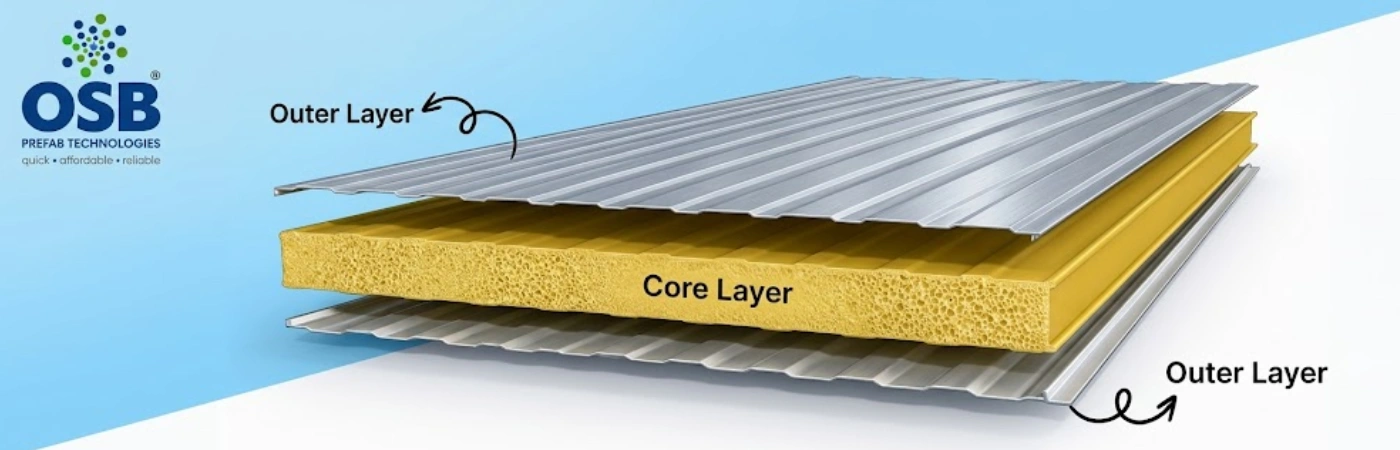
PUF sandwich panels are manufactured by bonding a rigid polyurethane foam insulation core between two protective facing sheets. The process involves preparing the metal sheets, forming the panel profile, injecting or foaming the insulation core, controlling curing conditions, and inspecting the finished panel. Proper manufacturing helps deliver consistent insulation, reliable joints, and durable panels for industrial buildings, cold rooms, and clean rooms.
When choosing PUF sandwich panels in Hyderabad and throughout India, OSB Prefab Technologies believes that buyers and project managers can make well-informed choices by comprehending this process.
What Are PUF Sandwich Panels?
PUF stands for polyurethane foam, a rigid insulating material commonly used in prefabricated building panels. A typical PUF sandwich panel consists of three main components: an outer facing sheet, a foam insulation core, and an inner facing sheet.
The two metal facings protect the foam and contribute to the panel’s structural performance. The rigid foam core reduces heat transfer, making the panels suitable for buildings where indoor temperature control is important.
Unlike conventional construction, where insulation and wall finishes may be installed separately, sandwich panels combine these functions in a prefabricated component. This can make project planning, implementation, and transportation easier.
What Materials Are Used to Manufacture PUF Sandwich Panels?
The quality of a finished panel depends on the compatibility and consistency of its raw materials.
1. Rigid Polyurethane Foam
Rigid polyurethane foam is the main insulation core. It is produced through a chemical reaction between suitable polyurethane system components, including a polyol blend and an isocyanate, with other formulation ingredients as required.
The resulting foam contains many small cells that help restrict heat transfer. Its density, cell structure, adhesion, and curing quality influence the performance of the finished panel.
2. Metal Facing Sheets
The outer and inner skins provide protection and contribute to the panel’s strength. Common options include:
- Pre-painted galvanized iron (PPGI): A coated steel facing used for many industrial and commercial applications.
- Galvanized steel (GI): A zinc-coated steel option selected according to project requirements.
- Stainless steel (SS): Used where corrosion resistance, cleaning requirements, or hygiene considerations make it suitable.
- Other approved facings: Aluminium or specialized boards may be considered for specific designs.
The appropriate facing depends on the environment, expected loads, exposure to moisture or chemicals, and maintenance requirements.
3. Coatings, Sealants, and Joint Components
Metal surfaces are shielded from environmental exposure and corrosion by coatings. Sealants and compatible joint components help reduce air leakage and moisture entry when correctly specified and installed.
Tongue-and-groove joints and cam-lock systems may be used for particular panel designs. The appropriate option depends on the application and the manufacturer’s configuration.
How Are PUF Sandwich Panels Manufactured? Step-by-Step Process
The manufacturing method varies between continuous production lines and discontinuous or batch-based systems. However, the main stages generally involve preparing the facings, forming the panel, creating the foam core, curing, finishing, and quality inspection.
Step 1: Raw Material Inspection
Before production begins, manufacturers check the incoming materials against the required specifications.
Metal coils or sheets may be inspected for thickness, surface condition, coating defects, and dimensions. The polyurethane system components are checked against the supplier’s specifications, including their storage conditions and suitability for the intended process.
This stage helps identify damaged sheets, contaminated materials, or unsuitable inputs before they enter production.
Step 2: Preparing and Forming the Metal Sheets
The facing sheets are unwound or prepared and passed through suitable forming equipment when a profiled panel is required. Roll-forming machinery can create ribs, grooves, or other profiles according to the panel design.
Flat facings may be used for applications where a smooth finish is preferred, such as some clean room wall systems.
Manufacturers must maintain the specified dimensions and profile alignment. Incorrect forming can affect the fit between adjoining panels and complicate installation.
Step 3: Applying the Polyurethane Foam System
The foam system is prepared according to the approved formulation and processing instructions. The relevant components are metered and mixed under controlled conditions.
The mixture is introduced between the facing sheets using the production method designed for the product. In a suitable process, the material expands to fill the intended core space.
Mixing accuracy, material temperature, processing time, and distribution affect the foam structure. These parameters must be controlled in accordance with the equipment and material supplier’s requirements.
Step 4: Foam Expansion and Bonding
After application, the polyurethane mixture reacts and expands. It fills the space between the two facings and develops a bond with the surfaces.
Consistent filling is important. Voids, poor adhesion, uneven core distribution, or excessive variation in thickness can affect the panel’s thermal and mechanical performance.
The manufacturer must use compatible facings, suitable surface preparation, and validated processing conditions to achieve reliable bonding.
Step 5: Curing Under Controlled Conditions
The foam needs sufficient time and appropriate conditions to complete its reaction and develop the required properties. Depending on the production method, panels may move through a controlled laminating or curing section, or remain in a suitable press or fixture.
Curing time and temperature vary with the polyurethane formulation, panel thickness, equipment, and process design. They should not be treated as identical for every product.
Proper curing helps the core maintain its intended structure and bond with the facing sheets.
Step 6: Cutting and Edge Finishing
Once the panel has reached the required stage of processing, it is cut to the specified length. The edges and joint profiles are finished according to the product design.
Depending on the panel type, finishing may include creating tongue-and-groove profiles, preparing cam-lock arrangements, checking overlaps, or removing excess material.
Accurate cutting helps panels align correctly during assembly and reduces unnecessary adjustments at the project site.
Step 7: Final Inspection and Packing
Finished panels undergo inspection before dispatch. The checks should reflect the product specification and intended application.
Panels that meet the acceptance criteria can then be protected, labelled, stacked appropriately, and prepared for transport. Correct handling helps prevent scratches, bent edges, damaged joints, and other defects that may affect installation.
Types of PUF Sandwich Panels Manufactured for Different Applications
The purpose of each PUF panel is different. The panel profile, joint configuration, facing material, thickness, and support requirements can differ according to the application.
PUF Wall Panels
Used for industrial partitions, warehouse walls, prefabricated buildings, and selected controlled environments. Panel thickness and facing finishes are chosen according to insulation, appearance, and service conditions.
PUF Roofing Panels
Designed for roof assemblies where insulation and weather protection are required. Profile geometry, roof slope, fasteners, overlaps, and drainage details are important to the finished system.
PUF Cold Room Panels
Used in refrigerated storage for food, dairy, pharmaceuticals, and other temperature-sensitive goods. Core thickness, joint sealing, vapour control, and compatible doors must match the required operating conditions.
PUF Clean Room Panels
Used in selected clean room walls, partitions, and ceiling systems. When paired with appropriate HVAC and room design, smooth, cleanable facings and well-sealed joints can support hygienic and contamination-control requirements.
OSB Prefab Technologies lists PUF panels with tongue-and-groove or cam-lock joints and facing options that include pre-coated GI and stainless steel. Review the specifications for the exact product before selecting a configuration.
Key Features and Benefits of Properly Manufactured PUF Panels
The benefits of a PUF sandwich panel depend on material quality, design, manufacturing consistency, and correct installation.
- Thermal insulation: The rigid foam core helps reduce heat transfer through the panel.
- Lightweight construction: Sandwich panels can reduce the weight of the wall or roof assembly compared with some conventional construction options.
- Prefabricated installation: Factory-produced dimensions can simplify site assembly and help shorten construction schedules.
- Joint integration: Compatible interlocking or cam-lock systems can help achieve a closer fit between panels.
- Versatile facing options: Different metal facings and finishes support a range of industrial and commercial requirements.
- Maintenance considerations: Suitable coatings and properly sealed joints can help protect the assembly during service.
- Potential energy savings: Insulated building envelopes can reduce heating or cooling loads, depending on the entire building design and operating conditions.
These advantages are not automatic guarantees. Poor installation, damaged facings, thermal bridges, air leakage, or unsuitable material selection can reduce actual performance.
Technical Specifications to Check Before Buying PUF Panels
- Core Material: Check the type and formulation of rigid polyurethane foam used for insulation.
- Panel Thickness: Choose the appropriate thickness based on insulation requirements and application.
- Foam Density: Verify the specified foam density and permitted manufacturing tolerance.
- Facing Material: Select suitable PPGI, GI, stainless steel, or other approved facing materials.
- Facing Thickness: Check the metal sheet thickness separately from the overall panel thickness.
- Thermal Conductivity: Review the declared thermal conductivity value and relevant test conditions.
- Joint System and Dimensions: Check tongue-and-groove or cam-lock joints, panel length, effective width, and dimensional tolerances.
- Structural and Fire Performance: Verify load-bearing data, support spacing, fixing requirements, and applicable fire-test reports.
The OSB Prefab PUF panel page lists a panel thickness range of 30–150 mm, foam density of approximately 40 ± 2 kg/m³, and thermal conductivity of 0.023 W/m·K. Before placing a purchase, verify the precise product configuration and current availability as these are listed product-page specifications.
Why Do Panel Thickness and Density Matter?
Panel thickness influences thermal resistance, but the required value also depends on the target indoor temperature, outdoor climate, building use, joints, and other sources of heat gain.
Foam density is one factor affecting core properties, but it should not be used alone to predict strength or insulation performance. Foam chemistry, cell structure, adhesion, facings, and the complete panel design also matter.
For a cold room, for example, a thicker panel may be required than for a general warehouse partition. The appropriate specification should be selected from the actual operating requirements rather than simply choosing the thickest available option.
Quality Checks During PUF Sandwich Panel Manufacturing
Quality assurance should take place throughout production, not just after a panel has been completed.
Raw Material Checks
Confirm facing thickness, coating condition, material identification, and polyurethane system documentation.
Dimensional Checks
Measure panel length, overall thickness, effective width, squareness, and edge-profile consistency against the approved specification.
Foam Core Inspection
Check for visible voids, uneven filling, local deformation, and other signs of inconsistent processing. Use appropriate sampling and test methods where required.
Bonding and Joint Checks
Evaluate facing-to-core adhesion and joint geometry using suitable inspection or test methods specified for the product.
Surface and Finish Inspection
Look for scratches, coating damage, dents, exposed core material, and defects that could affect appearance or service life.
Documentation and Dispatch Checks
Match product labels, quantities, dimensions, and any required inspection records to the purchase order and approved drawings.
For projects that require specific thermal, structural, or fire performance, request relevant test reports and documented acceptance criteria. A visual inspection alone cannot establish every performance characteristic.
Applications of PUF Sandwich Panels in Hyderabad and Across India
PUF sandwich panels are used in several types of buildings where insulation and prefabricated construction are beneficial.
- Industrial sheds and warehouses: Insulated walls and roofs can help manage indoor temperatures and improve building-envelope performance.
- Cold storage facilities: Properly designed panels support temperature-controlled environments for food, dairy, frozen products, and other temperature-sensitive goods.
- Pharmaceutical facilities: Where smooth surfaces and sealed seams are needed, panels can be used for the walls and ceilings of clean rooms.
- Food processing units: Appropriate panel finishes and hygienic detailing can help make surfaces easier to clean.
- Commercial and modular buildings: Prefabricated panels can simplify the assembly of selected wall and roof systems.
- Agricultural facilities: Suitable insulated panel systems may be used in poultry, processing, and storage buildings, depending on the environment.
For Hyderabad projects, consider summer heat, seasonal rainfall, the intended indoor conditions, roof exposure, and the building’s ventilation and cooling requirements. A panel alone cannot solve every thermal or moisture problem; the complete envelope and installation details must work together.
How to Select a Reliable PUF Sandwich Panel Manufacturer
Before choosing a manufacturer in Hyderabad or another Indian market, ask for clear answers to these questions:
- Are the proposed panel dimensions, facings, core density, and joint details documented?
- Can the supplier provide relevant test reports and product-specific technical data?
- Are the panels suitable for the intended application and environmental conditions?
- Are load tables and installation details available where structural performance matters?
- How are panels protected during packing, transport, handling, and storage?
- Can the manufacturer explain the recommended fixing, sealing, and maintenance procedures?
Frequently Asked Questions
1. What is the main material used in PUF sandwich panels?
Rigid polyurethane foam forms the insulating core. Metal facings, such as pre-painted galvanized steel or stainless steel, enclose the core and contribute to the panel’s durability and structural performance.
2. How are PUF sandwich panels manufactured?
The general process includes raw material inspection, metal sheet preparation, profile forming, foam mixing and application, expansion, curing, cutting, edge finishing, and final quality inspection. Exact steps vary by manufacturing equipment and panel design.
3. What is the standard thickness of PUF sandwich panels?
The product and intended use determine the thickness. OSB Prefab’s PUF panel page lists options from 30 mm to 150 mm. Insulation, temperature, and design specifications should all be taken into consideration when choosing the necessary thickness.
4. How is the quality of a PUF sandwich panel checked?
Quality checks can include dimensional measurements, facing inspection, foam core assessment, bonding evaluation, joint-profile checks, and review of relevant test documentation. The exact tests depend on the required product performance.
5. Which facing materials are used in PUF sandwich panels?
Common options include pre-painted galvanized steel, galvanized steel, and stainless steel. The best choice depends on corrosion exposure, hygiene requirements, appearance, cleaning methods, and the project environment.
6. Where are PUF sandwich panels commonly used?
They are used in industrial buildings, warehouses, cold storage facilities, clean rooms, food-processing units, and selected commercial or modular structures. The panel configuration must suit the intended application.
7. Are PUF sandwich panels suitable for Hyderabad’s climate?
They can be suitable for many Hyderabad projects because their insulating core helps reduce heat transfer. Actual performance depends on panel thickness, roof and wall design, joints, ventilation, solar exposure, and installation quality.
8. Why are quality checks important during manufacturing?
Quality checks help identify dimensional errors, surface damage, inconsistent foam filling, poor bonding, and joint defects before dispatch. This can reduce installation problems and help ensure that the delivered product matches its approved specifications.