

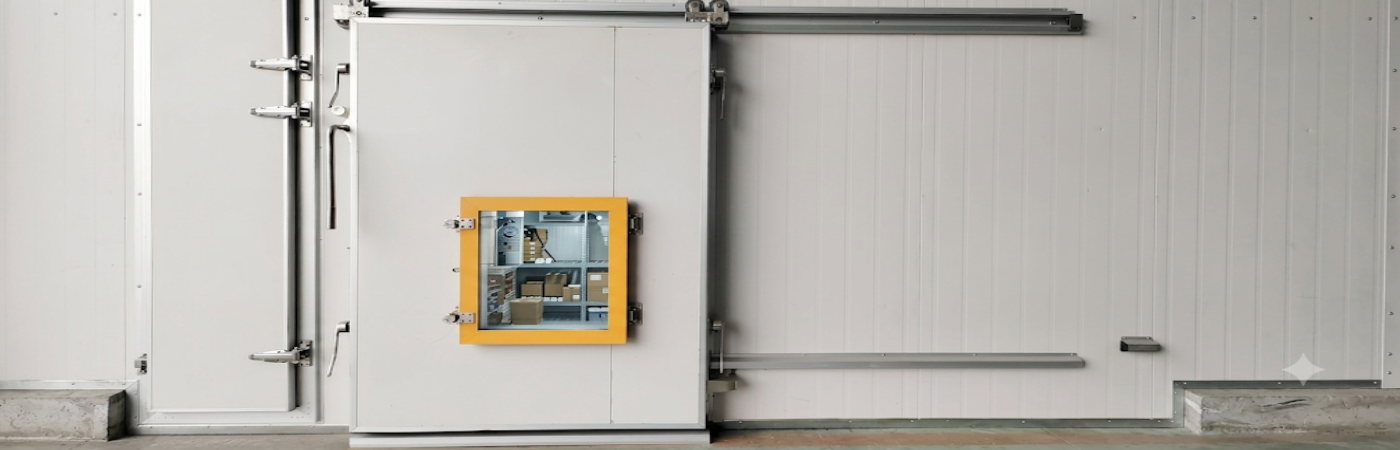
For businesses that need reliable temperature-controlled storage, choosing the right cold room panels and doors is essential. From food processing and dairy storage to pharmaceuticals, hospitality, laboratories, and distribution centers, a properly designed cold room helps maintain consistent temperatures, reduce energy consumption, and protect temperature-sensitive products.
OSB Prefab Technologies provides cold room panels and doors designed for commercial and industrial applications. This guide explains cold room panels, insulation, panel thickness, door types, pricing factors, applications, customization, installation considerations, and how to select a reliable cold room panel manufacturer in Hyderabad.
What Are Cold Room Panels?
Insulated sandwich panels used to create temperature-controlled spaces are known as cold room panels. They generally consist of an insulation core positioned between protective metal sheets. The insulated construction helps minimize heat transfer between the cold room interior and the surrounding environment.
Cold room panels are commonly used for refrigerated warehouses, food storage rooms, pharmaceutical facilities, dairy units, hotels, restaurants, laboratories, and cold-chain facilities.
The performance of a cold room depends on several factors, including insulation material, panel thickness, joint design, surface finish, room size, refrigeration system, installation quality, and operating temperature.
What Are Cold Room Doors?
Cold room doors are specially designed insulated doors that help maintain the internal temperature of a refrigerated or temperature-controlled room. Unlike ordinary doors, they are designed to reduce thermal leakage and provide a better seal around the opening.
Depending on the application, cold room doors may be available in different configurations, sizes, opening mechanisms, insulation specifications, and hardware options.
A properly selected door is important because frequent opening and closing can otherwise result in significant temperature fluctuations and increased refrigeration loads.
What Are Cold Room Panels Used For?
Cold room panels can be used in various industries where controlled temperatures are important. Common applications include:
- Food and vegetable storage
- Fruits and agricultural produce
- Dairy and milk products
- Meat and seafood storage
- Frozen food warehouses
- Pharmaceutical products
- Medical and laboratory applications
- Hotels and commercial kitchens
- Restaurants and food-processing units
- Distribution and cold-chain facilities
The appropriate panel specification depends on the required temperature, room dimensions, humidity conditions, product type, and operating environment.
Which Insulation Is Used in Cold Room Panels?
Cold room panels commonly use rigid insulation materials such as PUF (Polyurethane Foam) or PIR (Polyisocyanurate), depending on the project requirements.
The insulation core provides thermal resistance and helps reduce heat transfer. When selecting panels, businesses should evaluate not only the insulation material but also its density, thermal performance, panel thickness, joint construction, surface material, and manufacturing quality.
For a commercial cold room, choosing insulation based on the required operating temperature and application is more important than selecting a panel solely by price.
How Thick Should Cold Room Panels Be?
There is no single thickness suitable for every cold room. Panel thickness should be selected according to the required internal temperature, room size, ambient conditions, insulation performance, and intended application.
Common panel thicknesses may include approximately 50 mm, 75 mm, 100 mm, 120 mm, 150 mm, and other project-specific specifications.
For chilled applications, a comparatively thinner panel may be sufficient, while freezer and deep-freeze applications generally require greater insulation thickness.
A professional manufacturer should assess the application before recommending the appropriate panel thickness.
Can Food Be Stored in Cold Room Panels?
Yes. Properly designed cold room panels are widely used for food storage applications. They can help maintain controlled temperatures and provide an enclosed, hygienic environment.
Applications include:
- Fruits and vegetables
- Dairy products
- Meat and poultry
- Seafood
- Frozen foods
- Beverages
- Processed food
- Bakery products
For food applications, businesses should also consider cleanable surfaces, hygienic joints, moisture resistance, appropriate flooring, drainage, refrigeration capacity, and door performance.
Are Cold Room Panels Suitable for Pharmaceutical Storage?
Yes. Insulated cold rooms can be used in pharmaceutical and healthcare-related storage where controlled environmental conditions are required.
However, pharmaceutical storage generally demands stricter temperature control and monitoring than ordinary commercial storage. The complete system—including insulation, refrigeration equipment, doors, temperature monitoring, alarms, and installation—should therefore be designed according to the specific application and applicable requirements.
What Types of Cold Room Doors Are Available?
Cold room doors can be selected according to room size, traffic frequency, temperature requirements, and available space.
Common options include:
- Hinged cold room doors
- Sliding cold room doors
- Single-leaf doors
- Double-leaf doors
- Manual doors
- Heavy-duty industrial doors
- Customized cold room doors
For facilities with frequent movement of goods, sliding doors may provide practical access. For smaller rooms, hinged insulated doors can be suitable.
How Much Do Cold Room Panels Cost in Hyderabad?
The cost of cold room panels in Hyderabad varies according to several specifications rather than being determined by a single fixed rate.
Important pricing factors include:
- Panel thickness
- Insulation material
- Panel dimensions
- Sheet material and finish
- Insulation density
- Required temperature
- Quantity
- Customization
- Transportation
- Installation requirements
Therefore, businesses should request a project-specific quotation instead of comparing manufacturers only on per-square-foot pricing.
How Much Do Cold Room Doors Cost in Hyderabad?
The type, size, insulation thickness, hardware, opening mechanism, material, finish, and customization all affect the cost of a cold room door.
A small standard hinged door and a large industrial sliding door can have significantly different prices. Installation and specialized hardware can also influence the overall project cost.
For an accurate quotation, provide the manufacturer with the required door dimensions, application, temperature range, quantity, and preferred configuration.
How Do I Choose a Cold Room Panel Manufacturer in Hyderabad?
Consider the following factors:
1. Product Quality
Check the quality of insulation, metal sheets, joints, sealing components, and hardware.
2. Application Knowledge
Choose a manufacturer that understands food, pharmaceutical, industrial, hospitality, and other cold-storage requirements.
3. Customization Capability
The manufacturer should be able to provide panels and doors according to the dimensions and specifications of your project.
4. Technical Support
Design assistance, installation guidance, and after-sales support can be valuable for long-term operation.
5. Manufacturing Experience
Review the company’s experience, previous projects, product range, and ability to handle commercial or industrial requirements.
6. Complete Solution
A manufacturer capable of supplying both panels and compatible cold room doors can simplify procurement and coordination.
Where Can I Buy Cold Room Panels and Doors in Hyderabad?
Businesses can source cold room panels and doors directly from specialized manufacturers and suppliers in Hyderabad.
When evaluating suppliers, compare:
- Product specifications
- Insulation type
- Available thicknesses
- Door configurations
- Customization options
- Installation support
- Delivery timelines
- Warranty and service
- Overall project quotation
For commercial and industrial projects, buying directly from an experienced manufacturer can also make technical coordination easier.
Can Cold Room Panels and Doors Be Customized?
Yes. Cold room panels and doors can generally be customized to meet project-specific requirements.
Customization may include:
- Panel dimensions
- Thickness
- Door size
- Door configuration
- Surface finish
- Panel layout
- Joint configuration
- Hardware
- Room design
- Special openings and access requirements
Customization is particularly useful when the available building space or operating requirements do not match standard room dimensions.
How Long Do Cold Room Panels Last?
The service life of cold room panels depends on the quality of materials, manufacturing standards, installation, operating conditions, maintenance, moisture exposure, and frequency of use.
Properly manufactured and correctly installed insulated panels can provide long-term service when they are maintained appropriately.
Regular inspection of joints, seals, doors, surfaces, and areas exposed to moisture can help identify problems early and preserve the performance of the cold room.
How Do Cold Room Panels Improve Energy Efficiency?
Cold room panels help improve energy efficiency by reducing heat transfer between the cold interior and the warmer surrounding environment.
Effective insulation means the refrigeration system may need to work less intensively to maintain the desired temperature. Good panel joints and properly sealed doors further reduce unwanted air and heat infiltration.
Energy efficiency therefore depends on the complete cold room system, including:
- Insulation thickness
- Thermal performance
- Panel joints
- Door sealing
- Refrigeration equipment
- Room design
- Temperature settings
- Maintenance
- Frequency of door opening
What Is the Difference Between a Cold Room and a Normal Storage Room?
A normal storage room generally provides physical space for storing products but does not necessarily provide controlled temperature conditions.
A cold room is specifically designed to maintain a controlled low-temperature environment. It combines insulated panels, insulated doors, refrigeration equipment, and appropriate sealing to reduce heat transfer.
For temperature-sensitive products, a cold room provides significantly better environmental control than conventional storage.
What Factors Should I Consider Before Installing a Cold Room?
Before installing a cold room, evaluate:
- Required temperature: Determine whether the room is intended for chilled, frozen, or specialized storage.
- Room dimensions: Calculate the required storage capacity and available installation area.
- Product type: Different products have different temperature and humidity requirements.
- Panel thickness: Select insulation thickness based on operating conditions.
- Door requirements: Consider traffic frequency, door dimensions, and opening mechanism.
- Refrigeration: The refrigeration system must be appropriately sized for the room and application.
- Flooring: Insulated and suitable flooring is important for many cold-storage applications.
- Drainage: Moisture and condensation management should be considered during design.
- Power availability: Ensure adequate electrical infrastructure for refrigeration equipment.
- Future expansion: If storage requirements may increase, consider future capacity during the initial design.
Why Choose OSB Prefab Technologies for Cold Room Panels and Doors?
OSB Prefab Technologies focuses on providing practical prefabricated solutions for commercial and industrial requirements. Its cold room panels and doors can be considered for applications requiring insulated, temperature-controlled spaces.
Businesses can benefit from working with a specialized manufacturer that understands the importance of insulation, panel construction, door sealing, customization, and project-specific requirements.
When selecting cold room solutions, OSB Prefab Technologies can assist businesses in evaluating suitable panel and door configurations based on their application, room dimensions, temperature requirements, and project needs.
For businesses searching for cold room panel manufacturers in Hyderabad, cold room door manufacturers in Hyderabad, or cold room panel suppliers in Hyderabad, choosing a manufacturer capable of supporting the project from product selection through installation can help simplify the process.
Frequently Asked Questions
1. What are cold room panels?
Cold room panels are insulated sandwich panels used to construct temperature-controlled rooms. They reduce heat transfer and help maintain the required internal temperature.
2. What insulation is commonly used in cold room panels?
PUF and PIR are commonly used insulation materials. The appropriate option depends on the required temperature, application, panel thickness, and project specifications.
3. What thickness is best for cold room panels?
The suitable thickness depends on the room temperature, application, ambient conditions, and insulation requirements. Common options include 50 mm, 75 mm, 100 mm, 120 mm, and 150 mm.
4. Can cold room panels be used for frozen food?
Yes. Cold room panels can be used for frozen-food applications when the panel thickness, insulation, refrigeration system, flooring, and doors are appropriately designed for low-temperature operation.
5. Are cold room panels suitable for pharmaceutical storage?
Yes, they can be used for pharmaceutical storage where controlled temperatures are required. The complete system should be designed according to the specific storage and compliance requirements.
6. Which cold room door is best?
The best door depends on room size, traffic, temperature, available space, and operational requirements. Hinged and sliding insulated doors are common choices.
7. How much do cold room panels cost in Hyderabad?
Pricing varies according to insulation, thickness, sheet material, dimensions, quantity, customization, transportation, and installation. A project-specific quotation is recommended.
8. Can OSB Prefab Technologies provide customized cold room panels?
Yes. Cold room panels and doors can be designed and supplied according to project-specific dimensions and application requirements, subject to technical feasibility.
9. Where can I find cold room panel manufacturers in Hyderabad?
Businesses can approach specialized manufacturers such as OSB Prefab Technologies for cold room panel and door requirements and request specifications and project quotations.
10. How long do cold room panels last?
Their service life depends on material quality, installation, environmental conditions, usage, maintenance, and protection from moisture and physical damage. Properly installed systems can provide long-term service.